I am a subscriber to the magazine BusinessWeek and I really enjoy it, however I was shocked last week when I opened the covers to find a story about a new investment fund coming to America called SuperFund.
Now, most of you probably associate the term "Superfund" with the program run by the government to clean up hazardous waste sites across the country. However, over the coming months you will be coming to know about a new "Superfund", a hedge fund that is being rolled out to U.S. Investors that in time I believe will have more in common with hazardous waste then prudent investment management.
This new hedge fund is really not new, it has been around in Europe for a few years and is run by an Austrian by the name of Christian Baha, a true idiot. While he claims monster returns I wouldn't trust them. The first clue that Christian, is clueless comes when he states "Why shouldn't everyone be able to make above-average returns in any market?"
Why is this statement so incredibly stupid? For one thing it ignores the fact that if everyone earned above average returns everyone would be above average.........which is impossible. It is reminiscent of Lake Wobegon (Garrison Keillor) where "all the children are above average." The arrogance, stupidity, and naivity of Christian Baha is enough to give anyone pause, but if that weren't enough the fees to invest in his funds should be. In one fund you don't make a dime until the return hits 8.75%, then you only keep 75% of the returns after that, the other fund must hit nearly 11% before you begin making any money.
Mr. Baha is counting on two things to drive sales - Greed & Stature. He claims that his investment styles are only available to the rich, but he is bringing them to the masses. He is playing on people's innate desire to be "rich" or like the "rich". He advertises huge returns in order to draw you in, but don't be fooled, he is simply another charlatan. Same wolf, different sheeps clothing.
To be honest, I thought the BusinessWeek piece on Superfund was a parody. I thought to myself, if I wanted to make fun of some of the ridiculous schemes that are going on in American financial institutions I would create the SuperFund idea. What better name for a parody about a bad investment than Superfund, a term long associated with toxic waste? Alas, it is not a parody - you will see this advertised on T.V., newspapers, radio, and you may even see an investment bus advertising the fund.
Superfund is what it is, a toxic waste investment that should be avoided with serious money. Christian Baha does not deserve your money.
If you'd like a copy of the SuperFund story I can e-mail it to you.
Scott Dauenhauer, CFP, MSFP
Friday, March 03, 2006
Wednesday, March 01, 2006
What You Need To Know About Financial Advice
A good primer put together by TD Waterhouse - now TD Ameritrade (the custodian of my client's money) on the difference between a stock broker and an advisor. I think you'll find it interesting.
Scott
Scott


Sunday, February 26, 2006
Family Picture
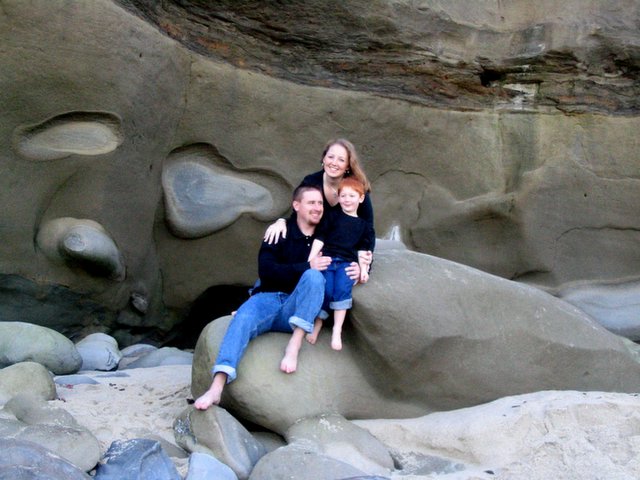 Thought I'd post an updated picture of me and my family. Collin is now 4 years old and is a bundle of energy. He is having a great time in his new home and new neighborhood and has made many friends that he just has too play with all the time!

Friday, February 24, 2006
H&R Block Reports Lower 3Q Earnings
Smartmoney.com: Print: NEWS WRAP: H&R Block Reports Lower 3Q Earnings
So this is how they can promise such large tax refunds....they simply do the return wrong!!!
If H & R can't do their own return correctly what makes you think they can do yours?
In all reality you'll probably do fine at H & R Block, but stay away from those Refund Anticipation Loans...I just thought this was a funny story!
Scott
So this is how they can promise such large tax refunds....they simply do the return wrong!!!
If H & R can't do their own return correctly what makes you think they can do yours?
In all reality you'll probably do fine at H & R Block, but stay away from those Refund Anticipation Loans...I just thought this was a funny story!
Scott
Trust broken, savings gone
News - Trust broken, savings gone - print version
I've been reporting on a ponzi scheme that happened up in Central and Northern California on my Teachers Advocate blog for some time now (http://teachersadvocate.blogspot.com), but it appears that tragedy has hit closer to home, this time in San Juan Capistrano.
Jeffrey Gordon Butler swindled nearly $15 million from investors, mainly seniors by promising high returns and using low cost Will & Trust services to gain access to seniors with money.
This is truly a sad case as over a hundred people have lost much of their life savings. A client of mine asked what was to stop me from doing the same thing, so I thought I'd lay out a few things that you can do to protect yourself.
1.) Verify that the person is licensed to do what he or she does. In this case a simple call to the National Association of Securities Dealers (www.nasdr.com), to the state insurance commissioners office, or the state department of corporations would have revealed that this individual was a fraud. Another way to verify this is by going to the Securities and Exchange Public website www.advisorinfo.sec.gov and searching for the individual or firms name. For example, if you put in my firms name (Meridian Wealth Management), my firm comes up and provides a complete disclosure.
2.) Verify credentials. This individual didn't have credential, but many planners do. You should first check out to see if the credential means anything (did they earn it over the weekend) and then verify that the individual holds that credential in good standing. I am a Certified Financial Planning Practitioner, or CFP and you can goto www.cfp-board.org and search on my name and find out that I am in good standing.
3.) You should get statements from a known entity, not statements made solely by the advisor. I produce my own client statements, but they are in addition to the statements that come from Ameritrade and TIAA-CREF - two companies that are well known. This prevents the advisor from having control of the money and commingling your money with his. You can call the provider up at any time and verify that the money is in the accounts and you can go online and check it out. In addition, these firms typically have huge insurance policies that protect your money from fraud by the firm.
4.) Never hesitate to ask lots of questions, a good advisor has nothing to hide.
5.) If it sounds too good to be true.......well, you know.
6.) Never make a check out directly to the individual or his/her firm (unless it is to pay a fee), only make checks out to the Brokerage firm or insurance company.
That should be enough to raise red flags, don't let fraud happen to you. Your advisor should be an open door and have no problem disclosing everything.
Scott Dauenhauer, CFP, MSFP
I've been reporting on a ponzi scheme that happened up in Central and Northern California on my Teachers Advocate blog for some time now (http://teachersadvocate.blogspot.com), but it appears that tragedy has hit closer to home, this time in San Juan Capistrano.
Jeffrey Gordon Butler swindled nearly $15 million from investors, mainly seniors by promising high returns and using low cost Will & Trust services to gain access to seniors with money.
This is truly a sad case as over a hundred people have lost much of their life savings. A client of mine asked what was to stop me from doing the same thing, so I thought I'd lay out a few things that you can do to protect yourself.
1.) Verify that the person is licensed to do what he or she does. In this case a simple call to the National Association of Securities Dealers (www.nasdr.com), to the state insurance commissioners office, or the state department of corporations would have revealed that this individual was a fraud. Another way to verify this is by going to the Securities and Exchange Public website www.advisorinfo.sec.gov and searching for the individual or firms name. For example, if you put in my firms name (Meridian Wealth Management), my firm comes up and provides a complete disclosure.
2.) Verify credentials. This individual didn't have credential, but many planners do. You should first check out to see if the credential means anything (did they earn it over the weekend) and then verify that the individual holds that credential in good standing. I am a Certified Financial Planning Practitioner, or CFP and you can goto www.cfp-board.org and search on my name and find out that I am in good standing.
3.) You should get statements from a known entity, not statements made solely by the advisor. I produce my own client statements, but they are in addition to the statements that come from Ameritrade and TIAA-CREF - two companies that are well known. This prevents the advisor from having control of the money and commingling your money with his. You can call the provider up at any time and verify that the money is in the accounts and you can go online and check it out. In addition, these firms typically have huge insurance policies that protect your money from fraud by the firm.
4.) Never hesitate to ask lots of questions, a good advisor has nothing to hide.
5.) If it sounds too good to be true.......well, you know.
6.) Never make a check out directly to the individual or his/her firm (unless it is to pay a fee), only make checks out to the Brokerage firm or insurance company.
That should be enough to raise red flags, don't let fraud happen to you. Your advisor should be an open door and have no problem disclosing everything.
Scott Dauenhauer, CFP, MSFP
Subscribe to:
Posts (Atom)