Wednesday, June 10, 2009

Hussman: Context Matters


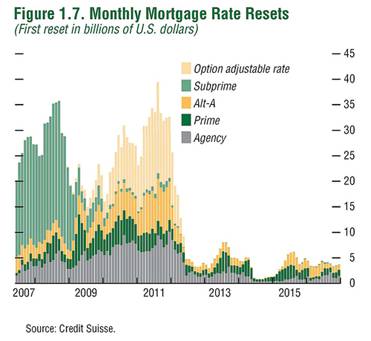
Hussman takes us through how he determines his hedges. In addition, he points out the huge increase in potential foreclosures coming our way. I've attached a graph, it ain't pretty.

Scott Dauenhauer CFP, MSFP, AIF
www.meridianwealth.com
949-916-6238
Monday, June 08, 2009

Deflation or Inflation? Or Both?


The big debate right now with economists is whether the United States will experience Inflation or Deflation. The short term view seems to be that deflation is a possibility, though the long view is that inflation is more likely. However, there are bright economists on both sides of the debate - both however cannot be right.

The inflation view, which I favor basically argues that massive deficits will lead to inflation. While deficits in and of themselves don't lead to inflation, these deficits are deemed to be so large (on top of already massive spending programs) that instead of financing the deficits with existing money supply, the Federal Reserve will have to finance them by purchasing the debt the treasury issues - thus expanding the money supply greatly and diluting the value of the dollar.

The deflation view makes sense in the short term as unemployment rises and people have less to spend, the prices of goods fall.

I'm not sure its wise to make a bet either way, but to maintain flexibility to react to whichever comes our way. My bigger fear is inflation and the high interest rates that could come with it.

Scott Dauenhauer CFP, MSFP, AIF
www.meridianwealth.com

Tuesday, June 02, 2009

Vintage pro-inflation propaganda

This is not a humor break, its the government in the 30's attempting to convince everyone that Inflation is great and will solve all your problems. Why is this important? I'm about to post two articles by individuals that tell you why.

Scott Dauenhauer CFP, MSFP, AIF
www.meridianwealth.com

Hussman: Anything But Academic

No commentary needed from me, just read it. Turns out Hussman was a student of John Taylor (prior post).

Scott Dauenhauer CFP, MSFP, AIF
www.meridianwealth.com

Exploding Debt Threatens America


Excerpt of article below by John Taylor

“A government debt burden of that [100 per cent] level, if sustained, would in Standard & Poor’s view be incompatible with a triple A rating,” as the risk rating agency stated last week.

I believe the risk posed by this debt is systemic and could do more damage to the economy than the recent financial crisis. To understand the size of the risk, take a look at the numbers that Standard and Poor’s considers. The deficit in 2019 is expected by the CBO to be $1,200bn (€859bn, £754bn). Income tax revenues are expected to be about $2,000bn that year, so a permanent 60 per cent across-the-board tax increase would be required to balance the budget. Clearly this will not and should not happen. So how else can debt service payments be brought down as a share of GDP?

Inflation will do it. But how much? To bring the debt-to-GDP ratio down to the same level as at the end of 2008 would take a doubling of prices. That 100 per cent increase would make nominal GDP twice as high and thus cut the debt-to-GDP ratio in half, back to 41 from 82 per cent. A 100 per cent increase in the price level means about 10 per cent inflation for 10 years. But it would not be that smooth – probably more like the great inflation of the late 1960s and 1970s with boom followed by bust and recession every three or four years, and a successively higher inflation rate after each recession."

I encourage you to read this article. Inflation is not an immediate threat, however given that a 60% tax rate is not something that could be passed by any congress (lets hope this to be true) the only way out is inflation (short of reigning in government spending, what a concept).

Scott Dauenhauer CFP, MSFP, AIF
www.meridianwealth.com
949-916-6238