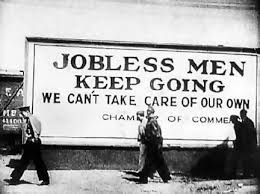
A recession is described in one of two ways, two consecutive quarters of negative GDP growth or whenever the National Bureau of Economic Research says its a recession. But where exactly did the term "recession" come from? The term came out of the Great Depression and it started being used "when the economy collapsed again in 1937, they didn't want to call that a new depression" says Robert S. McElvaine is Elizabeth Chisholm Professor of Arts and Letters and Chair of the Department of History at Millsaps College in Jackson, Mississippi. In other words, we didn't want to spook people into thinking we were having another depression (even though that is what it was and continued to be for many more years) and thus we invented "recession."
So what did we have before we had recessions? We had depressions, many of them actually, even one in 1920-21 that most have never heard about. Depression doesn't have an exact meaning, though many will tell you it is a retreat in GDP of about 10% - but it is really an extended hard-hitting recession. Before the Great Depression there was no such thing as a recession, it was simply called a depression. Most people don't know that America suffered many depressions throughout its history before the Great Depression. We only hear of the Great Depression, but that depression was Great because of how deep it was.
So are we in a depression right now? Well, GDP has not yet shrunk by 10% (though I promise that if the current Cap and Trade bill is passed it will surpass 10% - all politics aside), so technically we are not. In reality, using history before the Great Depression and simply living through this (compared to other recessions) we are now in a depression.
Yes, I said it, we are in a depression. But don't panic, America has been here before and pulled out. The reason I say we are now in a depression rather than a recession is because of a number of factors, Unemployment topping the list. The last time we saw unemployment at these levels was actually in the early 1980's, previous to that - The Great Depression.
Did you know that the current unemployment rate utilizing the most broad measure (BLS U-6) now stands at nearly 17%. This U-6 measure includes those who want to full time work but can't find it and are working part-time and those who have simply stopped looking. In some parts of the country this measure is now over
20%, yes 20% - see New York Times graphic c. In California unemployment is a tad over 20%, in my home state of Oregon it now stands at over 23% (higher than Michigan). The good news, if you can call it that is that the national 16%+ number is only half the same number during the Great Depression
(a similar, though not perfect apples-to-apples comparison showed 33% unemployment at the worst stage of the Depression).
So what is my other evidence? The weak and weakening financial sector being led by the Residential and Commercial real estate bust. Recent media reports talk of a turnaround in housing, perhaps a pricing bottom has occured, but if the oncoming wave of foreclosures is not stopped - things could get much worse. Our
massive national debt is growing at an unbelievable pace and the present value of our entitlement programs is so large as to make our national debt like chump change (somewhere in the $75 Trillion range over the next 75 years). The national debt problem does not include the massive shortfalls that face our states and municipalities in terms of pension and healthcare shortfalls.
Peter Morici, Professor of Business at University of Maryland in the above linked to Washington Post article says Morici says "a depression is a recession that "does not self-correct" because of fundamental structural problems in the economy, such as broken banks or a huge trade deficit."
If you hadn't noticed we have a broken banking system. Lending is compressing and loans are going bad at a feverish pace, without coordinated action we could have severe problems.
In the meantime savers are subsidizing the recovery by earning next to nothing on their savings while banks lend the money out at big spreads to try and cover the massive loan losses they are being forced to take.
The stock market is up, but that doesn't mean we are on the road to recovery, in fact the stock market climbed even higher after the 1929 crash only to crash again. I am not saying this is 1929 or that we will have another crash, but caution should rule the day.
The last time we had a similar economy was when Ronald Reagan took over the Presidency and our national deficit was only $900 billion (today that is the less than the annual deficit).
We are in a depression currently and history will bear this out. Its okay to call it a depression if you understand the word, its not yet a Great Depression and doesn't have to be. This is not a garden variety recession and we are not yet done, despite what the stock market might be saying. Note, this does not mean that the stock market won't continue to climb.
Okay, its been said, now lets start working our way out of this depression and get back on track for long-term prosperity.
Scott Dauenhauer CFP, MSFP, AIF